Estate cleanouts in North York
When a family home has to be emptied, the family decides what is kept, sold or given away. We carry out and haul what is left, room by room.
Who decides what goes
We take instructions from the person who has the authority to deal with the estate. In Ontario that is the estate trustee, named in the will or appointed by the court when there is no will. The trustee's job includes collecting the estate's assets and distributing what remains.
If you are not the trustee, check with them before you book a cleanout. If there is more than one trustee, agree between you first. We will ask who is giving the instruction.
This page is about the practical work. It is not legal advice. The Government of Ontario explains the trustee's role on its page about administering estates.
How a house gets emptied
The family goes first
Relatives take what they want before any hauling starts. Jewellery, documents, photographs and anything of value should leave the house with a family member.
Four labels
Go room by room with tape or sticky notes: keep, sell, donate, remove. We take only what is marked remove. If a whole room is going, one note on the door is enough.
We carry out and load
We empty one room at a time and work from the top floor down, with the basement last. Furniture, mattresses, appliances, kitchen contents, the garage and the shed.
Anything that turns up
Papers, photographs, cash, keys and anything with a name on it that we find in a drawer or behind furniture goes into a box for you. We do not decide what is important.
Swept and checked
Each room is swept when it is empty. You walk through before we leave.
What an older North York house holds
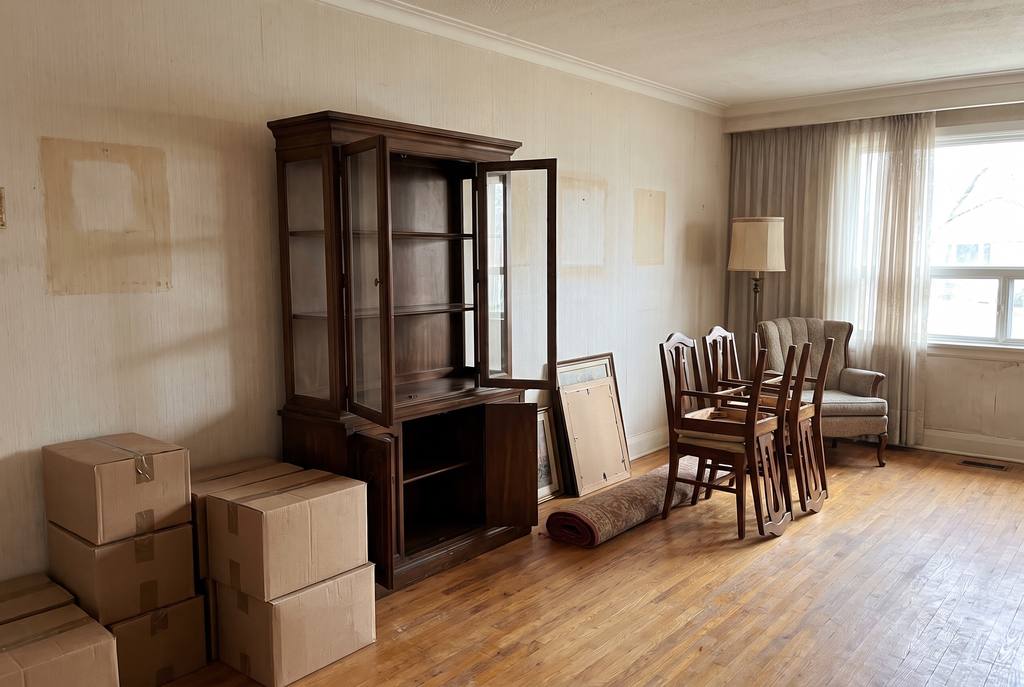
Some of the houses we are called to have had one family in them for decades. That means a dining room with a china cabinet and a full set of chairs, a basement with a workbench and a freezer, bedroom sets in solid wood, and closets that have not been emptied in years.
The heavy pieces are predictable: the china cabinet comes apart into a top and a base, the piano needs its own plan, and the freezer has to be emptied before anyone lifts it. The surprises are in the basement and the garage, where paint, chemicals and fuel have been kept.
A cleanout of a whole house is usually more than one truckload. We tell you in the quote how many loads we expect.
If it was a rented home
Different rules apply when the person who died was a tenant. These come from Ontario's Residential Tenancies Act.
- Thirty days
- When a tenant dies and no other tenants live in the unit, the tenancy is deemed to end 30 days after the death.
Source: Landlord and Tenant Board, Property left behind when a tenant moves out
- The landlord holds the belongings
- During those 30 days the landlord has to preserve the tenant's property in the unit, apart from anything unsafe or unhygienic, and give the executor or a family member reasonable access to remove it.
Source: Landlord and Tenant Board, Property left behind when a tenant moves out
- After that
- Once the tenancy has ended, the landlord may sell, keep or dispose of what is left. So the family has a fixed window to clear the unit.
Source: Landlord and Tenant Board, Property left behind when a tenant moves out
If the home is a rental, tell us the date the unit has to be empty when you send the request.
Details for a whole-house quote
- Rooms and storage
- Include the basement, attic access, garage and shed, with a rough count of large pieces and boxes in each.
- Heavy pieces
- Name the piano, safe, chest freezer or solid wood cabinet and tell us which floor it is on and how it gets to the door.
- Access and handover
- Tell us who can let us in, who decides what stays and the date the house has to be ready for the next person.
If you are donating some pieces, tell us which to leave.
Related work and North York access
Questions about estate cleanouts
Do we have to sort the house before you come?
Take out what the family is keeping. Past that, the labels are enough. You do not need to empty drawers or box up the kitchen.
Can you work to a closing date?
Tell us the date in the request. A full house usually takes more than one visit, so we plan back from the day the keys change hands.
What happens to papers and photographs you find?
They go in a box that stays with you. We do not throw out documents, photographs, cash or keys.
Sources for this page
- Government of Ontario, Administering estates
- Residential Tenancies Act, 2006
- Landlord and Tenant Board, Property left behind when a tenant moves out
Sources checked on 15 November 2026.
One house, one list
Tell us the kind of home, how many rooms and the date it has to be empty. We reply with a quote.